The intelligence layer for fintech professionals who think for themselves.
Primary source intelligence. Original analysis. Contributed pieces from the people defining the industry.
Trusted by professionals at JP Morgan, Coinbase, BlackRock, Klarna and more.
Join the FinTech Weekly Clarity Circle →
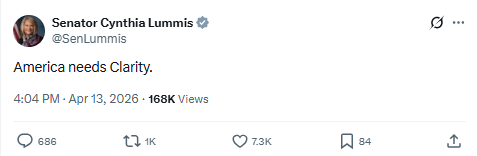
Senator Lummis posted three words on X this afternoon, the day the Senate returned from Easter recess. The word "Clarity" was capitalized. The double meaning was not ambiguous. The message reached 168,000 people within hours.
The Banking Committee's markup window is now open. Whether Chairman Tim Scott puts a date on it is the only question that matters this week.
Where the bill stands
The CLARITY Act enters this work period carrying the Tillis-Alsobrooks stablecoin yield text as its baseline. That text bans passive yield on stablecoin balances and permits only narrowly defined activity-based rewards. It is the version the banks can accept. It is also, as FinTech Weekly reported before the recess, the version Coinbase told Senate staff it could not support after reviewing the March 23 draft. The stablecoin yield question has a text. Whether it has consensus is a different matter.
Three other issues remain open. DeFi provisions are still contested, with several Senate Democrats citing illicit finance concerns. Ethics language, specifically a bar on senior government officials from personally profiting from crypto assets during their tenure, has not been agreed. The question of whether community bank deregulatory provisions are attached to the bill as part of a broader trade involving housing legislation was introduced in late March and has no public resolution.
What is missing from this window
David Sacks concluded his 130-day term as White House AI and crypto czar on March 26. No replacement has been named. The final committee push is proceeding without a dedicated White House coordinator inside the West Wing.
The administration's position remains visible through other channels. Treasury Secretary Bessent has called publicly for the Banking Committee to hold a markup. As FinTech Weekly mapped, the composition of the President's Council of Advisors on Science and Technology (PCAST) reflects where the White House sits on the remaining substantive questions. Marc Andreessen and Fred Ehrsam, both PCAST members, publicly backed the bill in January despite the yield restrictions. That alignment matters for what version of the bill exits committee.
The clock
Senator Hagerty said last week that he believed the bill could clear the Banking Committee during the work period beginning today and reach the full Senate before April's end. Senator Moreno has warned that if the bill does not advance by May, digital asset legislation may not receive serious consideration for years.
As FinTech Weekly mapped against the 2026 Senate calendar, a late April Banking Committee vote leaves the four remaining steps — a Senate floor vote requiring 60 votes, reconciliation with the Agriculture Committee version, reconciliation with the House version, and presidential signature — with a window measured in weeks.
Tim Scott has not announced a date. That is where things stand at the close of the first day back.
Editor's note: We are committed to accuracy. If you spot an error, a missing detail, or have additional information about any of the companies or filings mentioned in this article, please email us at [email protected]. We will review and update promptly.