
FinTech moves fast. News is everywhere, clarity isn’t.
FinTech Weekly delivers the key stories and events in one place.
Click Here to Subscribe to FinTech Weekly's Newsletter
Read by executives at JP Morgan, Coinbase, BlackRock, Klarna and more.
On March 9, Binance founder Changpeng Zhao posted on X that AI agents will make one million times more payments than humans, and those payments will run on crypto.
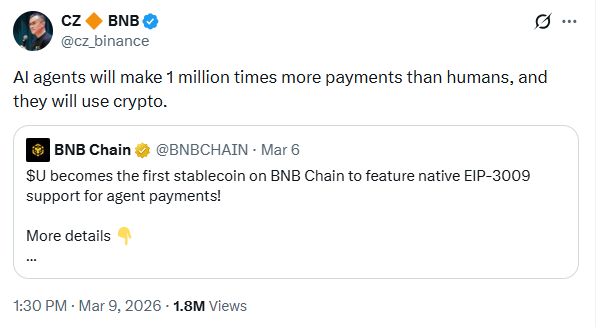
The reasoning behind it is structural. AI agents are software. They cannot satisfy the identity verification requirements that banks impose on account holders. Crypto wallets, which require only a private key to open and operate, have no such requirement. An agent that holds a crypto wallet can send and receive value without any human identity attached to the transaction.
Zhao's post appeared on the same day Coinbase CEO Brian Armstrong made a similar argument on X, stating that AI agents cannot meet Know Your Customer requirements and therefore cannot use traditional banking infrastructure. Armstrong pointed to Coinbase's Agentic Wallets, launched in February 2026 on its x402 protocol, as the infrastructure already operational for agent-native payments.
BNB Infrastructure for Autonomous Agent Payments
BNB Chain, Binance's blockchain network, deployed infrastructure for autonomous agent payments on February 4, 2026. The ERC-8004 standard, rolled out on BNB Chain's mainnet and testnet, creates verifiable on-chain identities for AI agents.
Alongside it, BAP-578 introduced Non-Fungible Agents, software entities that exist as on-chain assets, own wallets, and can hold and spend funds to complete assigned tasks without human authorisation at the transaction level. The two standards together create an identity and payments layer for agents operating on BNB Chain.
The AI Model
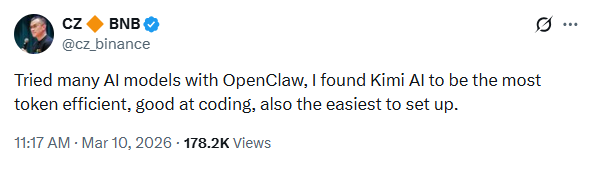
On March 10, one day after his prediction about AI agent payments, Zhao posted a follow-up on X about the tools he is currently using. Testing several AI models with OpenClaw, the open-source autonomous agent framework, he found Kimi AI to be the most token-efficient, effective at coding tasks, and the easiest to set up among the models he evaluated.
Kimi AI is developed by Moonshot AI, a Chinese artificial intelligence company founded in 2023. Its models are designed for long-context reasoning and have received attention in developer communities for performance on coding and multi-step tasks.
OpenClaw is an open-source framework for deploying autonomous agents that perform sequential tasks locally, without requiring a cloud service. It gained significant developer traction before OpenAI acquired the project earlier in 2026.
The post named three specific attributes: token efficiency, coding performance, and ease of setup, the factors most relevant to a developer deploying agents for autonomous task execution.
MarketsandMarkets projects the AI agents market will grow from $7.84 billion in 2025 to $52.62 billion by 2030, a compound annual growth rate of 46.3%.
Editor's note: We are committed to accuracy. If you spot an error, a missing detail, or have additional information about any of the companies or filings mentioned in this article, please email us at [email protected]. We will review and update promptly.